Smart Banners is a feature within Kochava that enables marketers to create targeted mobile web banners encouraging users to take actions such as downloading an app, registering for an account, or redeeming a limited-time offer. Many Kochava clients were previously paying for competitor solutions or building internal banner systems.
This created unnecessary costs, engineering overhead, and fragmented analytics. The Smart Banners feature was designed to give marketers a self-serve solution to launch, test, and measure mobile web banners directly within Kochava, while integrating seamlessly with existing Kochava tools such as SmartLinks.

Marketers needed a simple way to drive mobile growth from their websites, but existing options created friction.
Many Kochava customers were:
• Paying for additional third-party banner solutions
• Building inefficient internal tools
• Requiring engineering teams to deploy and update banners
• Lacking integrated performance insights tied to attribution
For growth teams, this slowed experimentation and increased costs.
Opportunity: Create a native Kochava feature that enables marketers to quickly launch and optimize targeted banners without engineering involvement.
The Smart Banners experience needed to allow marketers to:
• Quickly create and launch mobile web banners
• Customize messaging, placement, and timing
• Target specific audiences and use cases
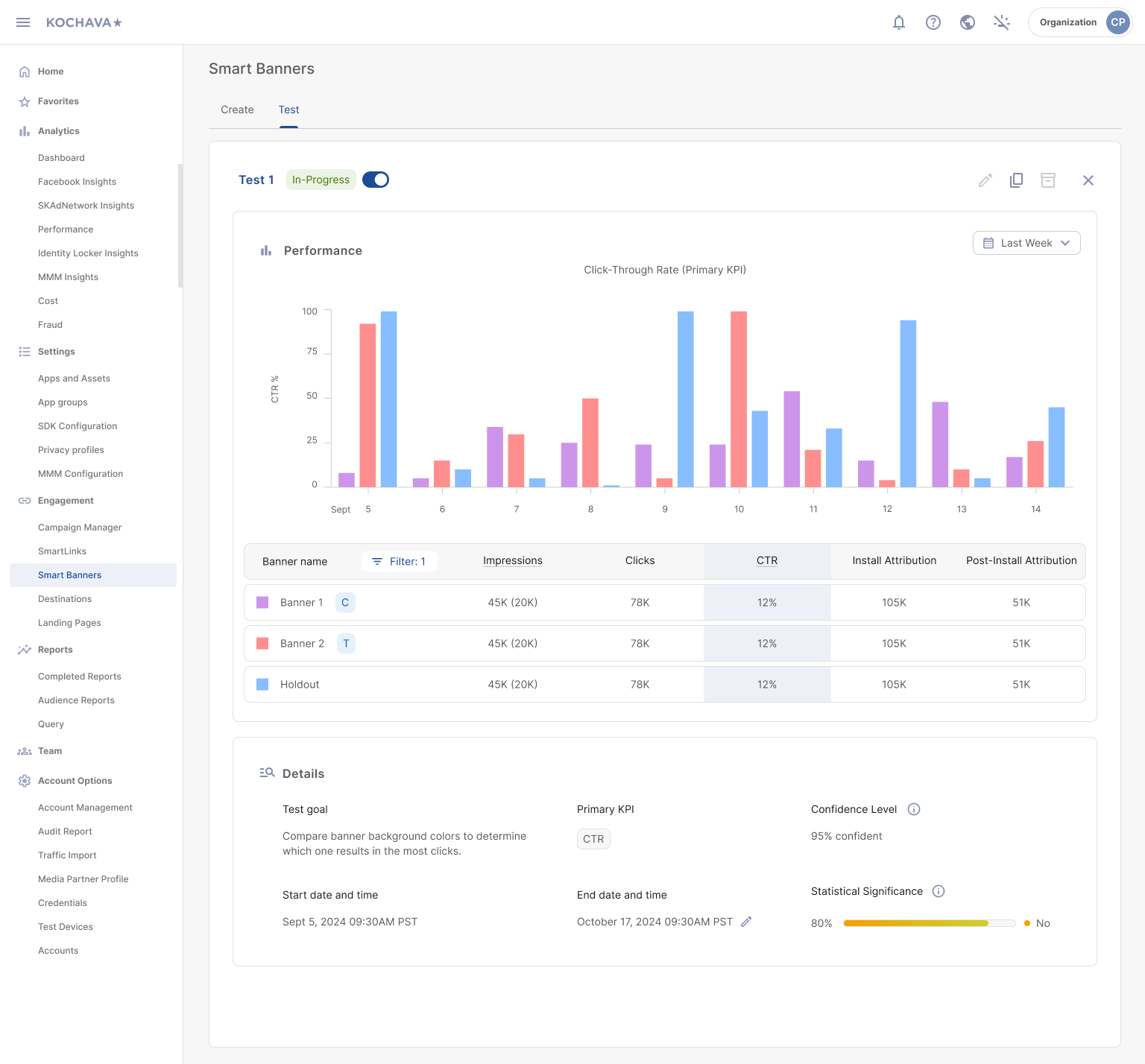
• Run A/B tests to optimize performance
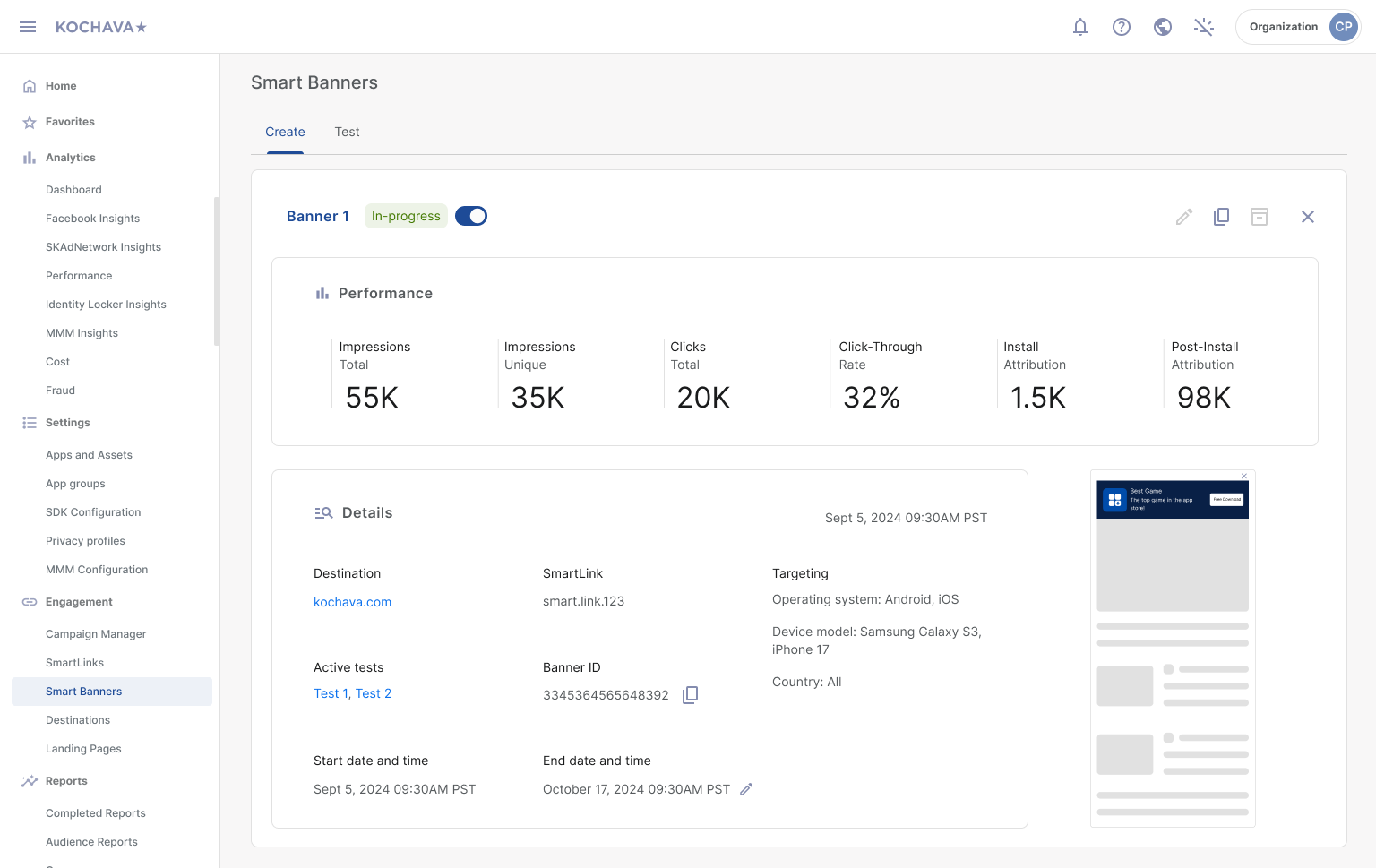
• Measure banner-driven growth and attribution
• Integrate seamlessly with Kochava SmartLinks
Ultimately, the goal was to help customers drive app downloads, registrations, and re-engagement directly from their owned web channels.

Owned brand marketers
Growth and lifecycle marketers responsible for driving engagement through mobile web and mobile apps.
Common use cases include:
• Driving app installs from mobile websites
• Promoting limited-time offers
• Encouraging account registration
• Re-engaging existing users

Data teams and BI analysts
These users ingest banner performance data into analytics systems to measure growth and campaign impact.
I was the sole product designer responsible for the Smart Banners experience.
My responsibilities included:
• Defining the UX for banner creation and management
• Designing end-to-end user flows
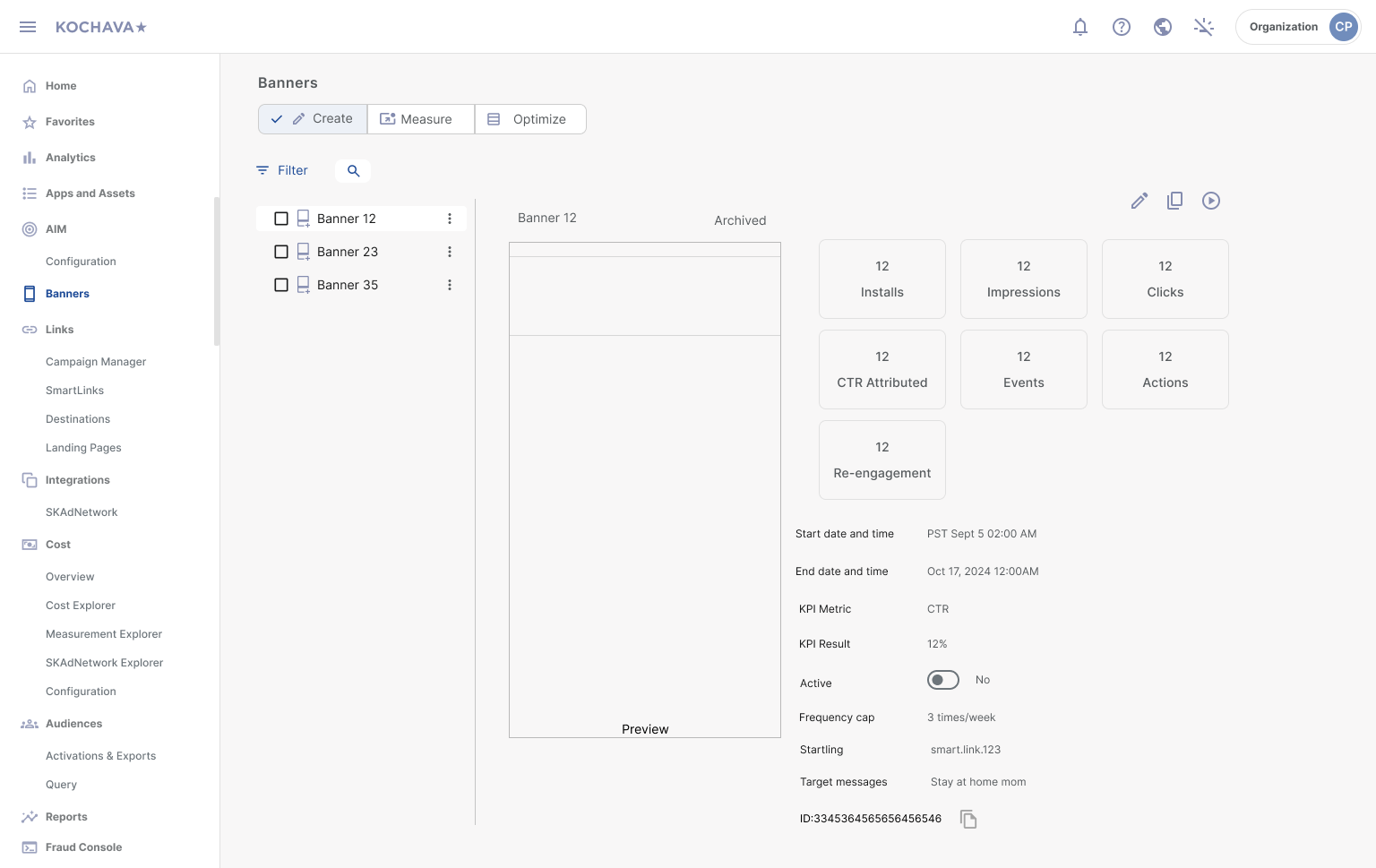
• Creating wireframes and interaction models
• Developing high-fidelity UI designs
• Building interactive prototypes for stakeholder review
• Iterating on designs with product managers and engineers
• Incorporating feedback from early customer usage
I collaborated closely with:
• Product managers
• Engineering teams
• Marketing teams responsible for go-to-market
Through discussions with product managers, engineers, and customers, several key insights emerged.
1. Marketers needed a self-serve workflow
Existing solutions required engineering teams to implement or update banners, slowing experimentation.
2. Banner creation needed flexibility
Marketers wanted control over:
• Creative assets
• Messaging
• Timing and display rules
• Audience targeting
3. Optimization was critical
Growth teams wanted the ability to run A/B tests and measure banner performance without relying on external tools.
4. Integration with existing Kochava tools was essential
Customers wanted Smart Banners to work seamlessly with Kochava’s SmartLinks, ensuring consistent attribution and measurement.
Several UX challenges emerged while designing the feature:
Balancing power with simplicity - Marketers needed advanced targeting and testing capabilities without overwhelming configuration steps.
Structuring the banner setup workflow - The system required marketers to configure multiple elements:
• Creative assets
• Targeting rules
• Placement and timing
• Messaging personalization
• Testing configurations
The experience needed to remain intuitive while supporting these options.
Supporting experimentation - Growth teams needed the ability to run tests and analyze results within the same workflow.
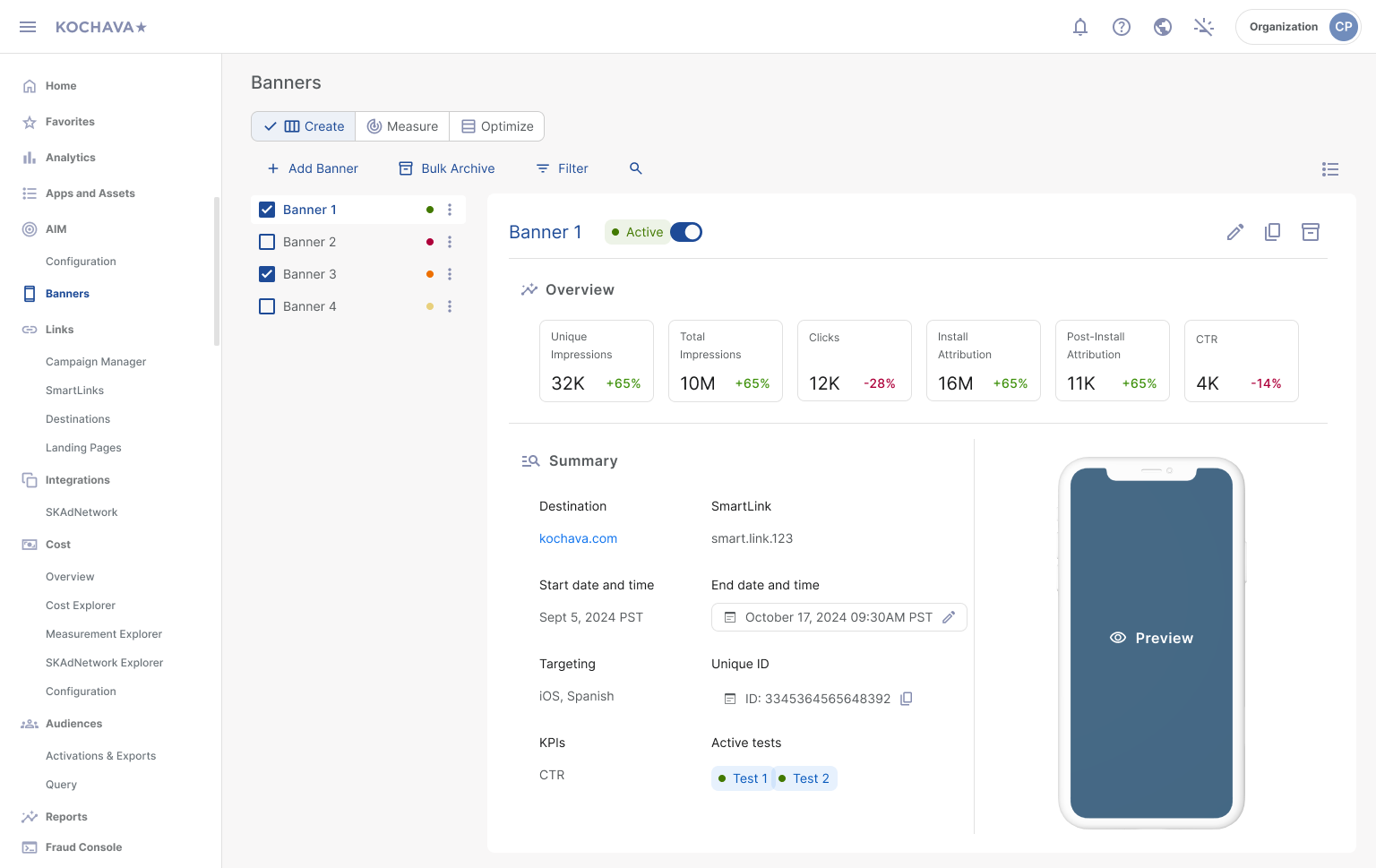
One of the most important structural decisions was separating creatives from test configurations.
Creatives contain:
• Visual assets
• Messaging content
• Banner layout
Test configurations define:
• Targeting rules
• SmartLinks destinations
• Location URL rules
• A/B test variations
This separation allowed creatives to be reusable across multiple experiments and campaigns, making it easier for marketers to iterate and optimize without rebuilding assets.
The result was a more scalable and flexible system for experimentation.
I began by mapping the core banner creation flow and creating low-fidelity wireframes to explore:
• Setup workflows
• Configuration hierarchy
• Banner preview interactions
These early explorations helped validate the structure with product and engineering teams.

After initial feedback, I refined the workflow to:
• Reduce cognitive load in configuration steps
• Clarify relationships between creatives and tests
• Improve discoverability of targeting options
Multiple iterations were tested with internal stakeholders.

Once the workflow was finalized, I developed high-fidelity designs and prototypes showing:
• Banner creation flows
• Configuration interfaces
• Preview states
• Testing and optimization setup
These prototypes helped align teams before development.

As customers began using the feature, I spoke with several early adopters to understand their experience.
Feedback identified:
• Areas where configuration could be clearer
• Opportunities to improve banner setup efficiency
• Additional optimization features marketers wanted
These insights informed ongoing iterations to the product.
Smart Banners helped Kochava expand its growth tooling for marketers by providing a solution for mobile web engagement.
The feature allowed customers to:
• Launch targeted banners without engineering involvement
• Reduce reliance on third-party banner tools
• Run experiments and optimize growth campaigns
• Measure the impact of banner-driven user actions
By integrating with SmartLinks, the feature also ensured that banner performance remained tied to Kochava’s attribution and analytics ecosystem.
This project was an opportunity for me to design a complex, data-driven product feature from the ground up.
I learned how to:
• Structure flexible systems for experimentation
• Balance advanced configuration with usability
• Collaborate closely with engineers on technical constraints
• Incorporate feedback from real customers
If I continued evolving the feature, I would focus on improving experiment insights and visualization, helping marketers quickly understand which banner variants drive the strongest results.